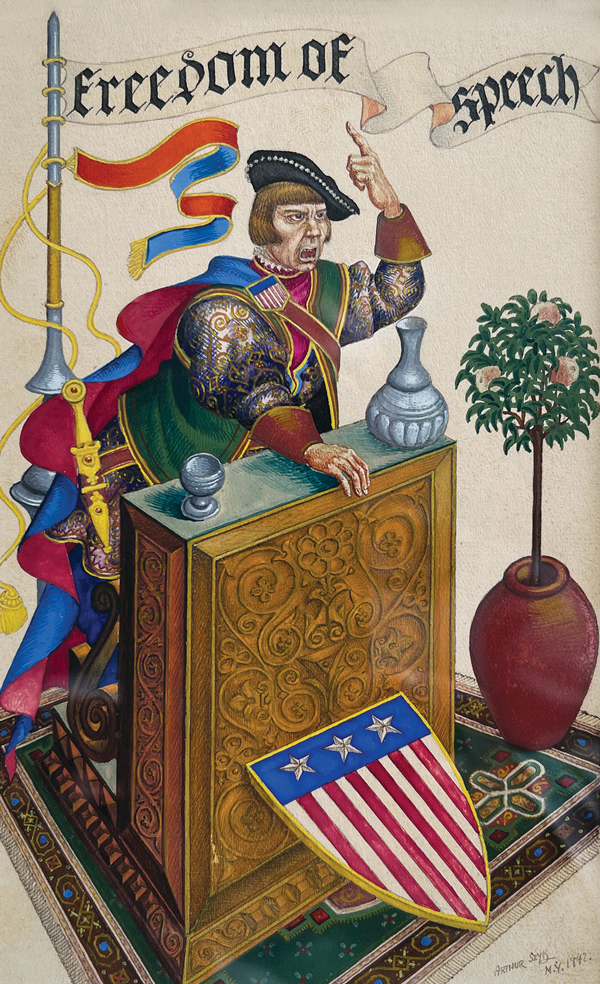
Freedom of Speech
Freedom of Speech
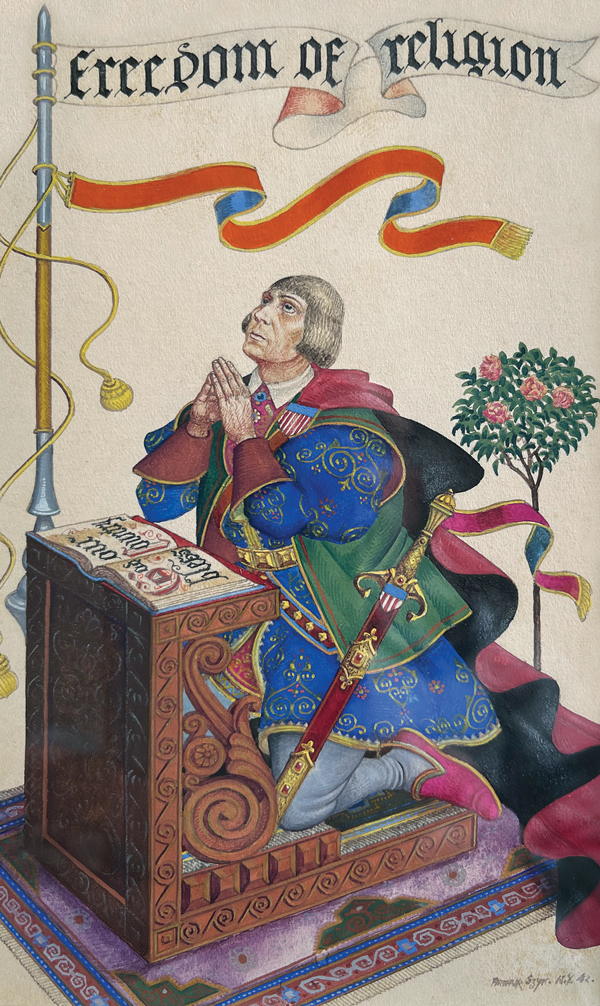
Freedom of Religion
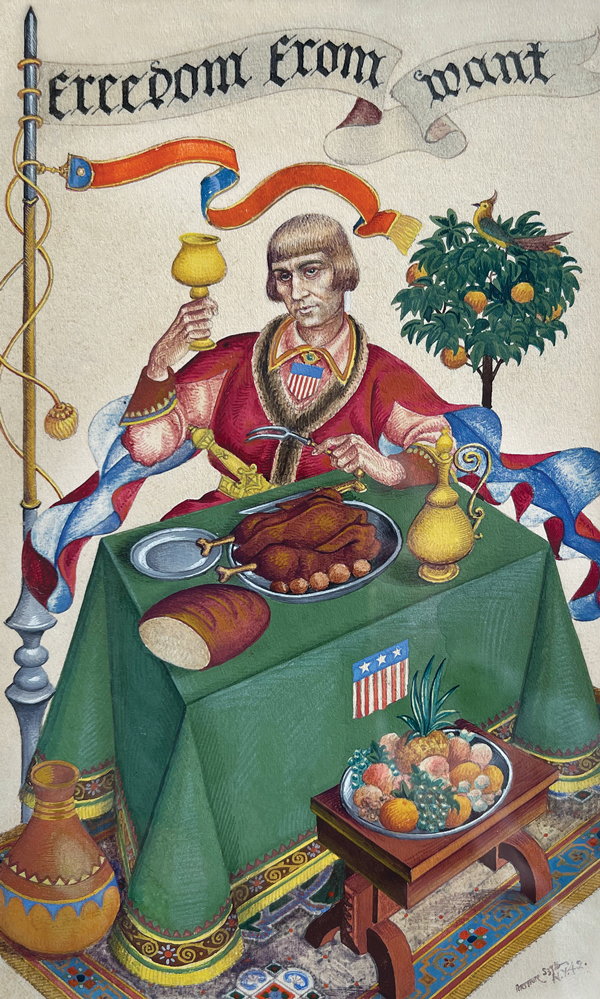
Freedom from Want
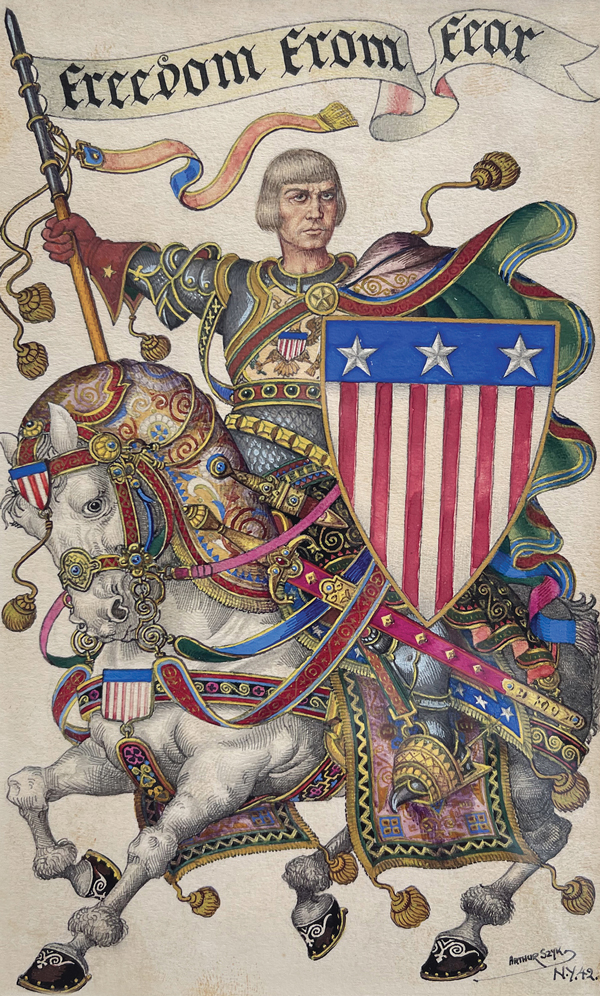
Freedom from Fear
In a world as complicated and challenging as ours, freedom of individual dignity is an elusive concept for most. Yet simply put, our pursuit of Four Freedoms offers a path for global communities to provide the setting and opportunity for enhanced and cherished living for each of us. Arthur Szyk’s knight reminds us that we must intentionally work toward these freedoms with a fighting spirit and guard them with eternal vigilance. This portfolio suite serves as a unifying visual reminder of those essential Four Freedoms and the role which beauty, color, and the attention to detail can serve in elevating our own inner spirit in our daily lives.
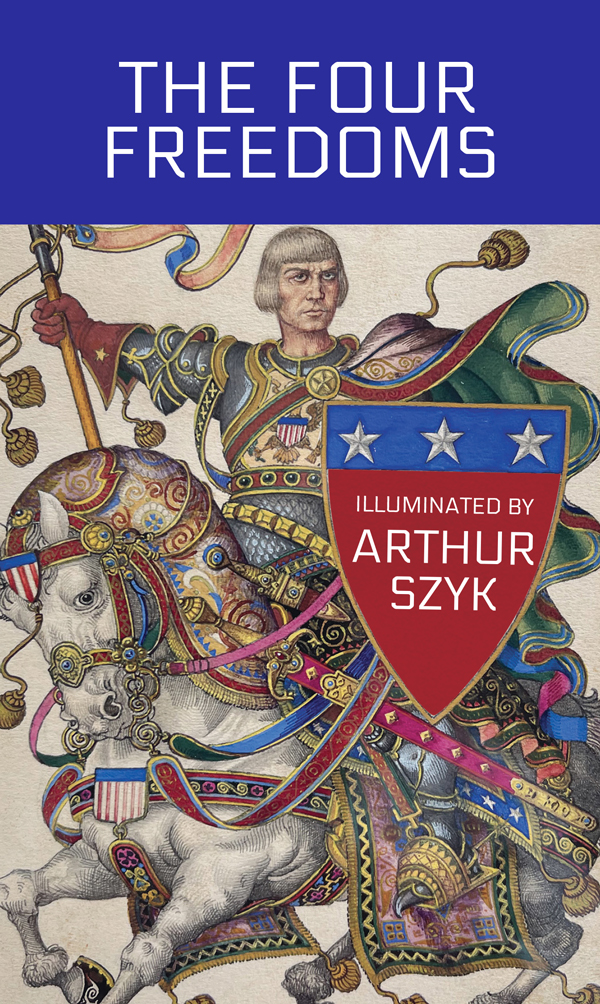 Limited Numbered Edition Set of Four Giclée Prints on Special Imported Paper
Sheet size of individual prints: 10 x 8 inches. Limited Edition to 200 sets, each print individually hand-numbered.
Portfolio includes original Four Freedoms poster stamp (printed 1942) , and 12-page booklet (numbered and signed by publisher).
The Four Freedoms Portfolio Suite is perfectly suited for framing in a single frame for display in home or office or as a special gift for a friend or honoree in handsome presentation folder.
To order, phone Historicana at (650) 343-9578 or click below:
*Shipping is not included in the listed price. Applicable sales tax will be added where required.
Custom Framed Four Freedoms Portfolio Suite
A. Horizontal
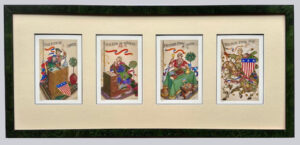
Measures 15 x 33 inches. Framed in dark green Roma Italian burlwood with 4-ply flannel rag mat with green fillet, UV glass.
B. Vertical
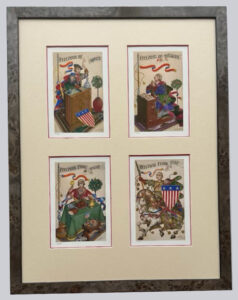
Measures 25 x 19 inches. Framed in taupe (light brown) Roma Italian burlwood with 4-ply flannel rag mat with red fillet, UV glass.
To order, phone Historicana at (650) 343-9578 or click below:
*Price of $1250 includes custom framing and shipping within the United States
The original artwork, watercolor and gouache paintings were on exhibition at the
Museum of Jewish Heritage, 36 Battery Place, New York City December 7, 2025—July 26, 2026
Click the plus + buttons below to open the following text descriptions:
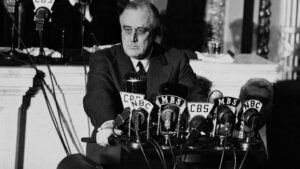
FDR delivering his State of the Union address, January 6, 1941.
On January 6, 1941, eleven months before the United States entered World War II, President Franklin D. Roosevelt delivered his State of the Union address to the US Congress and to an uneasy and nervous American public. Following the Japanese bombing of Pearl Harbor in Hawaii on December 7, 1941, America declared war on Japan and—a few days later—on Germany. In what is often referred to as his “Four Freedoms” speech, the president proposed four freedoms that he believed should be protected globally: freedom of speech, freedom of worship, freedom from want, and freedom from fear. These marked the principles upon which America would take up arms and fight for universal freedom.
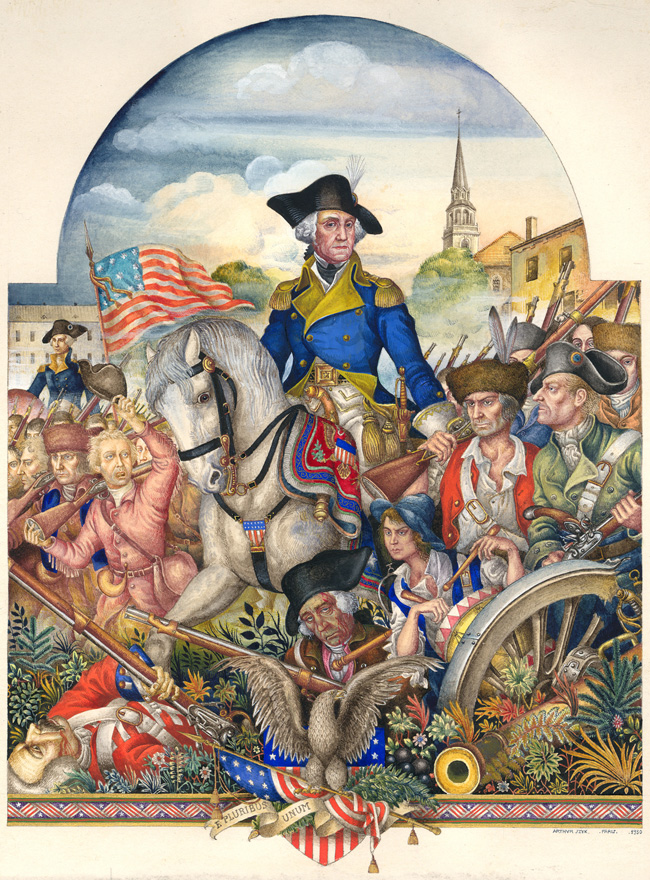
Arthur Szyk. George Washington the Soldier from Washington and His Times, Paris, 1930.
At the time of FDR’s speech, thirty-eight paintings of freedom were hanging in the White House. These paintings, which paid tribute to George Washington and the American Revolution, symbolized the freedoms for which America fought in the eighteenth century. Who was the artist of these gem-like miniature historical works of art, collectively titled Washington and His Times? Arthur Szyk. His watercolor and gouache paintings were completed in 1930 in Paris, purchased directly from him by the president of Poland, Ignacy Mościcki, in 1935, and gifted that same year to the president of the United States. Those paintings now reside at the Franklin D. Roosevelt Presidential Library and Museum in Hyde Park, New York.
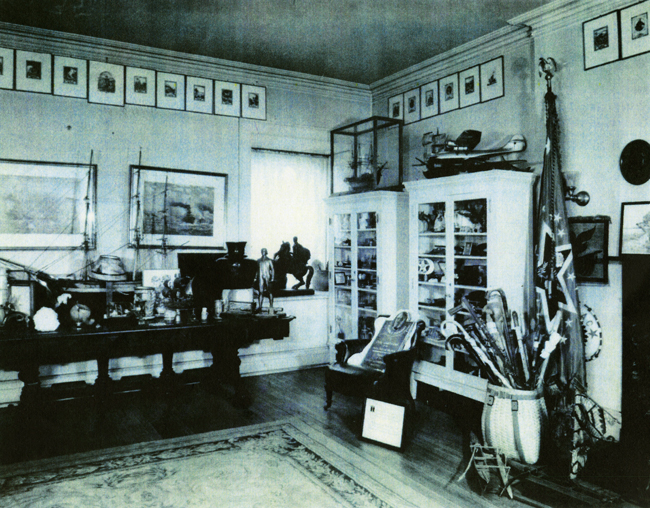
Arthur Szyk’s art in the White House before being moved to the FDR Presidential Library.
In 1940, Arthur Szyk (b. 1894 Łódź, Poland—d. 1951 New Canaan, Connecticut) immigrated to the US from London where he was then living. He went on to become America’s leading anti-Nazi artist in its fight against fascism, its dictators and its accomplices. His World War II role was attested to by First Lady Eleanor Roosevelt who wrote in her syndicated newspaper column My Day that Szyk was fighting the Axis “as truly as any of us who cannot actually be on the fighting fronts.”
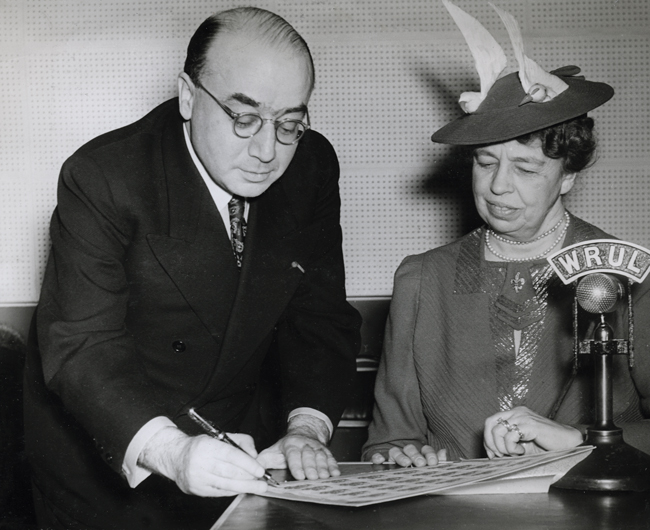
Szyk presents to First Lady Eleanor Roosevelt signed poster stamps created to raise funds for the British-American Ambulance Corps. New York, 1941.
In his 1944 portrait of President Roosevelt, which Szyk later gifted and inscribed to Mrs. Roosevelt, he signed his name as “F.D.R.’s Soldier in Art.” For that is how he saw himself—as a fighting artist.
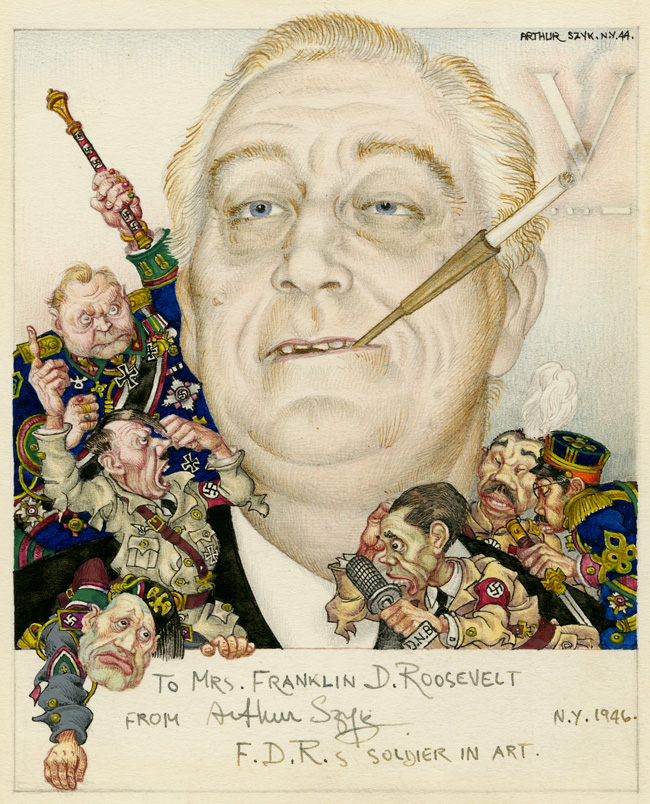
Arthur Szyk. F.D.R.’s Soldier in Art, New York, 1944 (inscribed in 1946).
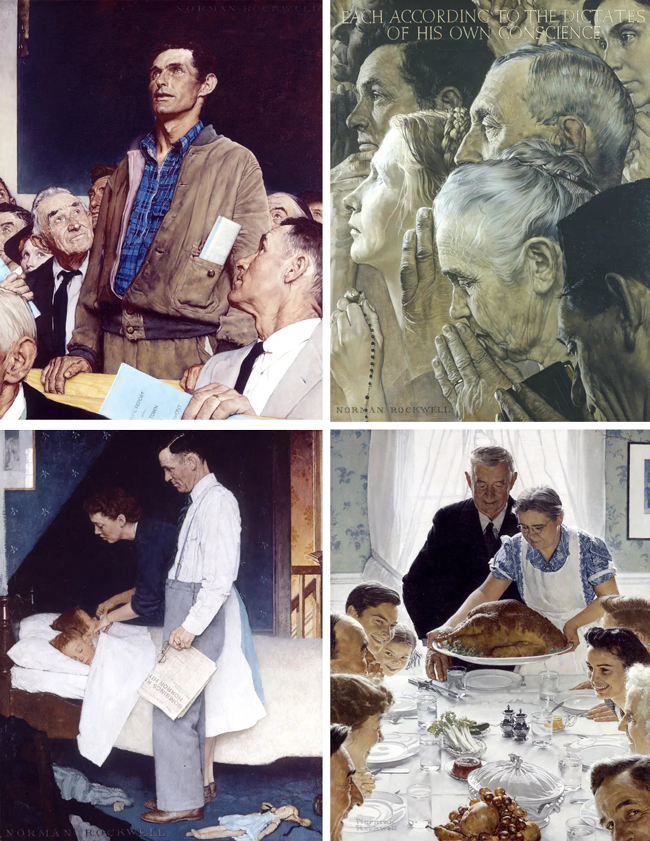
Norman Rockwell. Four Freedoms. Arlington, Vermont, late 1942/early 1943. Oil on canvas. Each 45 ¾ x 35 ½ inches.
FDR’s Four Freedoms became popularized and most well-known through the artwork created by Norman Rockwell (born the same year as Szyk, in 1894, in New York City). Following the creation of his four paintings toward the end of 1942, Rockwell’s works were reproduced in successive weekly issues of the Saturday Evening Post, beginning in February 1943. The Post and the United States Department of the Treasury exhibited the original artwork throughout the country during which it raised over $132 million for US war bonds.
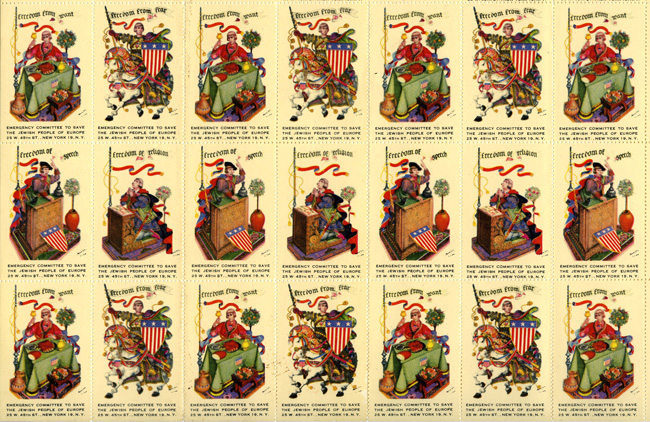
Four Freedoms stamp sheet. New York, 1942. Issued by the Emergency Committee to Save the Jewish People of Europe, New York.
What is not as well known today is that Arthur Szyk also painted the Four Freedoms in 1942. At the time, he was totally engaged in the war effort, using his motivational and supportive art on behalf of the US government and its soldiers fighting against the Axis of Germany, Japan and Italy. Additionally, Szyk’s art focused on calling attention to and raising money for the rescue of European Jews. His collaboration with Jewish activist Peter Bergson and with playwright Ben Hecht led him to take an active role as a vice-president in Bergson’s committees and as their one-man art department. One of his projects was the creation of the Four Freedoms paintings and their reproduction as poster stamps for the Emergency Committee to Save the Jewish People of Europe.
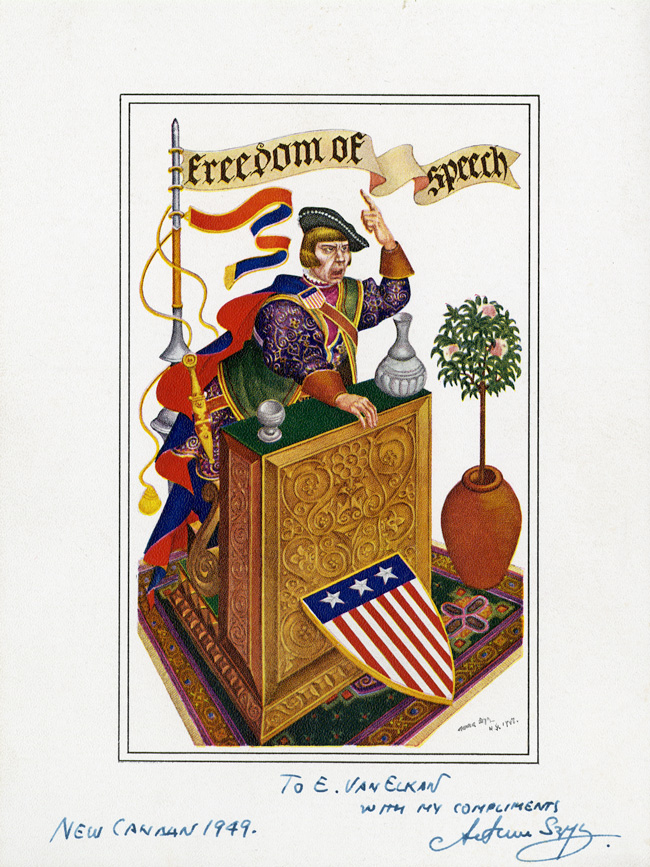
Postcard inscribed and dated by Szyk.
Szyk’s Four Freedoms paintings were also reproduced as enlarged postcards, and additionally became an essential element in the awards presented by the Four Freedoms Foundation (now the Franklin and Eleanor Roosevelt Institute) to prominent American heroes and leaders. Among the recipients were former World War II US Army Chief of Staff George C. Marshall (1952), former president Harry S. Truman (1953), and New York’s first Jewish governor and later its senator Herbert H. Lehman (1954).
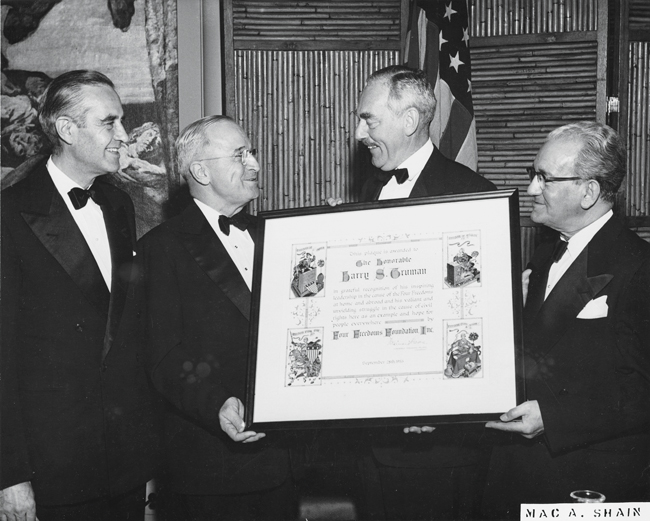
Harry S. Truman accepting a Four Freedoms Foundation award featuring Szyk’s art. Waldorf Astoria, New York, September 28, 1953.
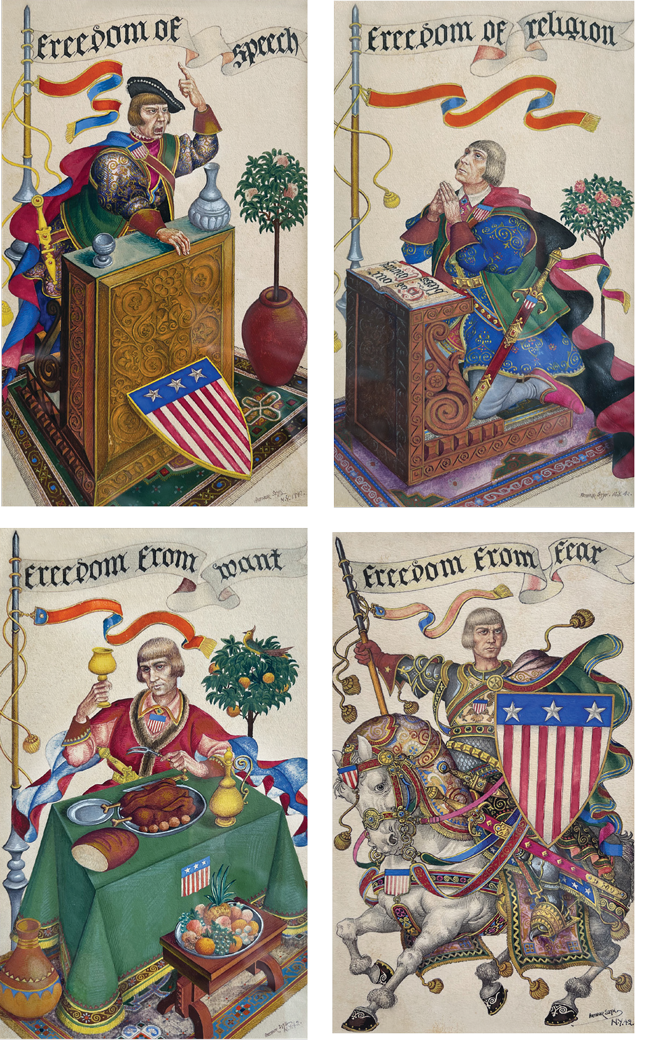
Arthur Szyk. Four Freedoms. New York, 1942. Watercolor and gouache on paper. Each 6 ¼ x 4 inches.
In Szyk’s Four Freedoms, the medieval knight is featured as the central figure, often accompanied with a shield emblazoned with the American stars and stripes. The knight appears—speaking, praying, feasting, and riding off to war—visually enacting each of the Four Freedoms. Szyk’s choice of the knight evokes the act of chivalry—symbolizing honor and the moral obligation to defend democracy—prepared to fight with lance, sword and shield to safeguard the fundamental rights of humanity.
FREEDOM OF SPEECH
In Freedom of Speech, the knight stands behind a podium, passionately delivering a speech to an unseen audience. The podium, which sits on an ornate rug, is intricately carved in a traditional European style. A shield donning a version of the American flag is propped up against the podium. To the side of the podium sits a potted fruit tree, and behind it is an ornamental staff. The staff has a banner that reads “freedom of speech.”
FREEDOM OF RELIGION
In Freedom of Religion, the knight kneels and prays, looking up at a banner that bears the titular message. In front of him lies an open book that reads “God bless our Country” in decorative script. Behind the knight is a red rose bush, and beneath him is a rug similar to that in Freedom of Speech.
FREEDOM FROM WANT
In Freedom from Want, the knight sits at a table with a feast in front of him raising a glass to the viewer. In his other hand, he holds a serving fork. There is an unoccupied stool opposite the knight and closest to the viewer, upon which rests a plate full of imported fruits. Behind the knight stands an orange tree with a bird perched on it.
FREEDOM FROM FEAR
Freedom from Fear shows the knight riding a horse while holding a lance and shield. The horse is adorned with decorative gold elements and a caparison—an ornamental covering placed over the saddle—that resembles the carpets from the other paintings.
Allison Claire Chang article “Visualizing the Four Freedoms: FDR’s Fighting Artist, Arthur Szyk” online in The Nation, January 8, 2016.
Irvin Ungar essay “Immigrant Artist as FDR’s Soldier in Art” in Enduring Ideals: Rockwell, Roosevelt & The Four Freedoms, New York: Abbeville Press, 2018.
Irvin Ungar. Arthur Szyk: Soldier in Art. London: GILES and Burlingame, California: Historicana, 2017. (National Jewish Book Award winner).
The digital files for the prints in this portfolio were edited by Irene Morris, Morris Design, Asheville, North Carolina. Printing was done by Katie Tackman, KT Butterfield Photography and Design, Philadelphia, Pennsylvania using an ultra-high resolution, eight color ink jet process on equipment manufactured by Epson. The Bugra paper was specially formulated and made for Historicana by Hahnemühle in Dassel, Germany. Brochure design by Isabel Webre. Text by Irvin Ungar.